
Table of Contents
ToggleIntroduction
SEO stands for Search Engine Optimisation. It is the practice of improving your website so it ranks higher in Google and other search engines – bringing in free, consistent organic traffic without paying for ads.
When someone types “best free SEO tools” into Google, thousands of websites compete for the top spots. SEO is what determines which websites appear first. Think of it as the bridge between what people are searching for and the content you have created.
In 2026, with AI-powered search results changing how Google displays information, understanding SEO is more important than ever. This guide covers everything a beginner needs to know to get started.
Why SEO Matters in 2026
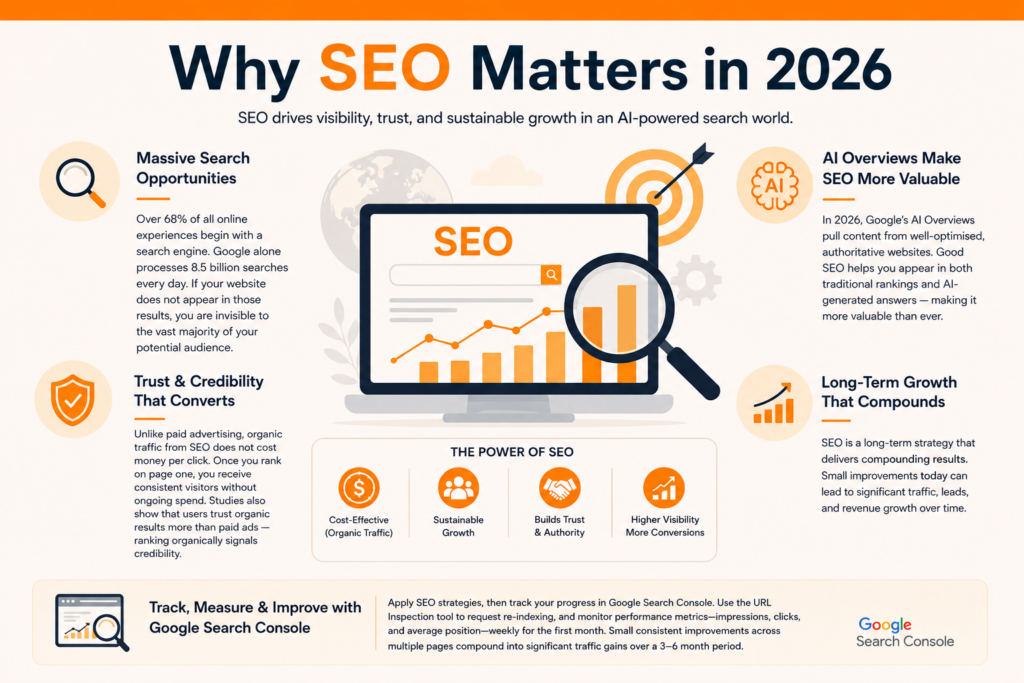
Over 68% of all online experiences begin with a search engine. Google alone processes 8.5 billion searches every day. If your website does not appear in those results, you are invisible to the vast majority of your potential audience.
Unlike paid advertising, organic traffic from SEO does not cost money per click. Once you rank on page one, you receive consistent visitors without ongoing spend. Studies also show that users trust organic results more than paid ads – ranking organically signals credibility.
In 2026, Google’s AI Overviews pull content from well-optimised, authoritative websites. Good SEO helps you appear in both traditional rankings and AI-generated answers – making it more valuable than ever.
Applying the strategies above to what is SEO is most effective when you track your progress in Google Search Console. After implementing any change, use the URL Inspection tool to request re-indexing, then monitor your page’s performance metrics – impressions, clicks, and average position – weekly for the first month. Small consistent improvements across multiple pages compound into significant traffic gains over a 3–6 month period.
SEO vs Paid Advertising - Key Differences
Factor | SEO (Organic) | Paid Ads (PPC) |
Cost per click | Free | ₹10–₹500+ per click |
Time to results | 3–6 months | Immediate |
Long-term value | Compounds over time | Stops when budget runs out |
User trust | High (organic) | Lower (labelled ‘Sponsored’) |
Sustainability | Builds permanently | Requires ongoing spend |
Best for | Long-term growth | Instant traffic & testing |
How Search Engines Work
Search engines operate in three stages. First, crawling – Google sends bots called Googlebots that follow links across the internet and discover new content. Second, indexing – discovered pages are stored in Google’s massive database. Third, ranking – when someone searches, Google sorts through billions of indexed pages and ranks them based on relevance, authority, and user experience.
Your website needs to be crawlable (accessible to bots), indexable (not blocked), and rankable (relevant and authoritative) to appear in search results.
Applying the strategies above to what is SEO is most effective when you track your progress in Google Search Console. After implementing any change, use the URL Inspection tool to request re-indexing, then monitor your page’s performance metrics – impressions, clicks, and average position – weekly for the first month. Small consistent improvements across multiple pages compound into significant traffic gains over a 3–6 month period.
The 3 Types of SEO
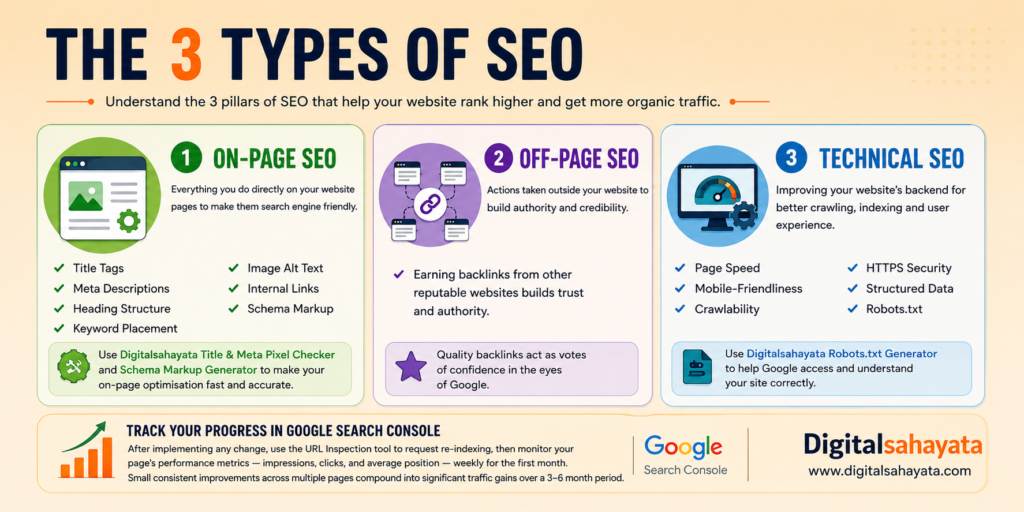
1.On-Page SEO covers everything you do directly on your pages – title tags, meta descriptions, heading structure, keyword placement, image alt text, internal links, and schema markup. Tools like the free Digitalsahayata Title & Meta Pixel Checker and Schema Markup Generator make on-page optimisation fast and accurate.
2.Off-Page SEO refers to actions outside your website that build authority – primarily earning backlinks from other websites. When reputable sites link to yours, Google treats it as a vote of confidence.
3.Technical SEO focuses on your website’s backend – page speed, mobile-friendliness, crawlability, HTTPS security, and structured data. Tools like the Digitalsahayata Robots.txt Generator help ensure Google can access and understand your site correctly.
Applying the strategies above to what is SEO is most effective when you track your progress in Google Search Console. After implementing any change, use the URL Inspection tool to request re-indexing, then monitor your page’s performance metrics – impressions, clicks, and average position – weekly for the first month. Small consistent improvements across multiple pages compound into significant traffic gains over a 3–6 month period.
Type | What It Covers | Key Tools on Digitalsahayata |
On-Page SEO | Titles, meta, content, schema, alt text, URLs | Title Checker · Schema Generator · Alt Text Tool |
Off-Page SEO | Backlinks, brand mentions, digital PR | Disavow File Generator |
Technical SEO | Speed, crawling, indexing, robots.txt, sitemap | Robots.txt Generator · Breadcrumb Generator |
How Long Does SEO Take?
SEO is a long-term investment. Most websites begin seeing meaningful results after 3 to 6 months of consistent effort. The process follows a predictable pattern: months 1–2 are foundation building with minimal visible results; months 3-4 show early ranking movement; months 5-6 bring real traffic growth; and after 12 months, results compound significantly.
The key is consistency. Unlike ads that stop working the moment you stop paying, good SEO continues delivering traffic indefinitely.
Applying the strategies above to what is SEO is most effective when you track your progress in Google Search Console. After implementing any change, use the URL Inspection tool to request re-indexing, then monitor your page’s performance metrics – impressions, clicks, and average position – weekly for the first month. Small consistent improvements across multiple pages compound into significant traffic gains over a 3–6 month period.
How to Start SEO Today
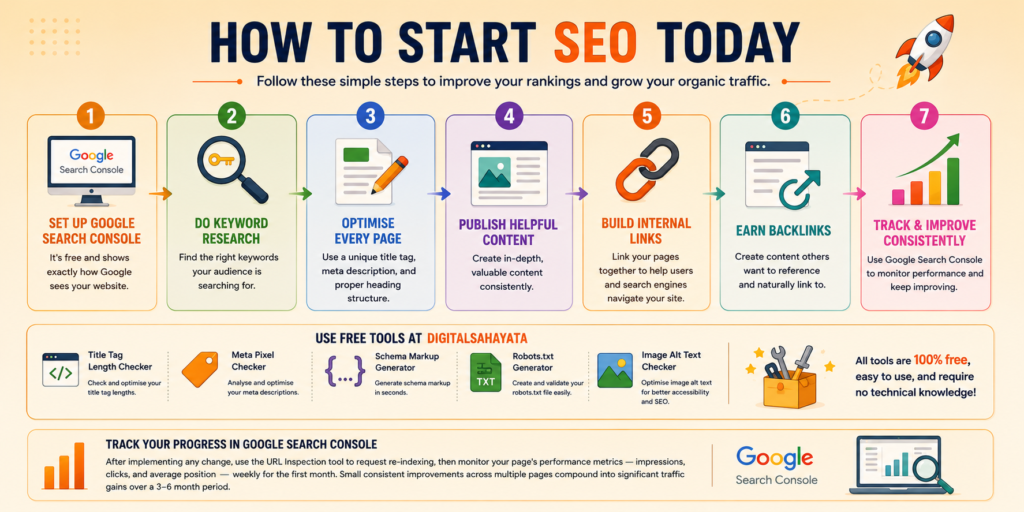
Start by setting up Google Search Console – it is free and shows exactly how Google sees your website. Then do basic keyword research to find what your audience searches for. Optimise every page with a unique title tag, meta description, and proper heading structure. Publish helpful, in-depth content consistently. Build internal links between your pages. And earn backlinks by creating content others want to reference.
Use the free tools at Digitalsahayata to check your title tag lengths, generate schema markup, create your robots.txt file, and optimise image alt text – all without any technical knowledge.
Applying the strategies above to what is SEO is most effective when you track your progress in Google Search Console. After implementing any change, use the URL Inspection tool to request re-indexing, then monitor your page’s performance metrics – impressions, clicks, and average position – weekly for the first month. Small consistent improvements across multiple pages compound into significant traffic gains over a 3–6 month period.
SEO Timeline — Realistic Expectations
Month | Expected Progress | Focus Activity |
Month 1–2 | Indexing begins, zero visible rankings | Technical setup, content publishing |
Month 3–4 | Rankings appear on pages 3–8 | Content quality, internal linking |
Month 5–6 | Page 1 appearances for long-tail keywords | Backlink building begins |
Month 7–12 | Multiple page-1 rankings, traffic grows 3–5× | Scaling content and links |
Year 2+ | Compounding authority, brand searches grow | Topical authority, advanced schema |
SEO Ranking Factors — What Google Weighs Most
Google’s algorithm uses over 200 ranking signals, but research consistently identifies the same top factors that drive most of the ranking variation across competitive search results.
Content quality and relevance remain the most important factor. Google wants to serve the best, most comprehensive answer to every query. Pages that fully satisfy a user’s search intent – covering the topic in depth, with accurate information and clear structure – rank above shallow competitors regardless of other factors.
Backlinks from authoritative, relevant websites are the second most powerful signal. Each quality backlink acts as a vote of confidence from another publisher. The more reputable the linking site, the stronger the signal.
User experience signals – page loading speed, mobile-friendliness, Core Web Vitals scores – have grown significantly in importance since Google’s Page Experience updates. A slow, difficult-to-use page loses rankings even if its content is excellent.
E-E-A-T (Experience, Expertise, Authoritativeness, Trustworthiness) affects how Google evaluates your content’s credibility – especially for health, finance, legal, and other high-stakes topics.
Common SEO Myths Debunked
Several persistent myths mislead beginners and waste their time and resources.
Myth 1: ‘More keywords = better rankings.’ Reality: keyword stuffing triggers Google penalties. One well-placed primary keyword per page, written naturally throughout the content, consistently outperforms pages stuffed with repetitions.
Myth 2: ‘Paid ads help organic rankings.’ Reality: Google explicitly confirms that running Google Ads has no effect on organic search rankings. The two systems are completely separate.
Myth 3: ‘SEO results come overnight.’ Reality: organic rankings take time to build. New websites typically require 3–6 months of consistent effort before meaningful organic traffic appears.
Myth 4: ‘Social media shares improve rankings.’ Reality: Google has confirmed social signals are not direct ranking factors. However, social sharing drives traffic and increases the chance of earning backlinks – which do affect rankings.
Myth 5: ‘You need expensive tools to succeed at SEO.’ Reality: free tools from Google and Digitalsahayata cover all fundamental SEO needs. Paid tools offer additional competitive intelligence but are not required for strong results.
Quick Action Steps — Implement Today
Follow these steps to apply everything in this guide to your website immediately:
- Audit your current pages for what is SEO gaps using Google Search Console
- Implement the core best practices on your top 3-5 pages first
- Use the relevant free Digitalsahayata tools to streamline implementation
- Test changes using Google’s free tools (Rich Results Test, PageSpeed Insights)
- Request indexing for updated pages via Google Search Console URL Inspection
- Monitor performance metrics weekly for the first month after implementation
Conclusion
SEO is not magic or a quick fix – it is a long-term investment in making your website more useful, trustworthy, and visible. The three pillars of on-page, off-page, and technical SEO work together to improve how Google understands and ranks your content.
The best time to start SEO was when you launched your website. The second best time is right now. Use the free tools at Digitalsahayata to begin optimising your website today.
Mastering what is SEO is a high-return investment in your website’s long-term search performance. The strategies, tables, and tools in this guide give you everything needed to implement, measure, and continuously improve. Start with the Quick Action Steps above, use Digitalsahayata’s free tools to execute each task, and commit to tracking your results in Google Search Console weekly.
SEO rewards consistency above all. A website that improves a little every week outperforms one that makes a massive single effort and then stagnates. Build the practices from this guide into your regular workflow, and your rankings will compound significantly over the next 6 – 12 months.
FAQs
What does SEO stand for?
SEO stands for Search Engine Optimisation. It is the process of improving a website’s visibility in organic (unpaid) search engine results.
Is SEO free?
The practice of SEO is free – you do not pay Google to rank your website. You will invest time and effort, and possibly tools, but organic rankings themselves cost nothing.
How long does SEO take to work?
Most websites see meaningful results in 3 to 6 months. Results compound over time – a site investing in SEO for 12+ months often sees exponential traffic growth.
Do I need coding skills for SEO?
No. Most SEO tasks can be completed with free tools like those on Digitalsahayata – no coding required. A basic understanding of HTML is helpful but not necessary.
Is SEO the same as SEM?
On-page SEO refers to changes made directly on your website – content, titles, and headings. Off-page SEO refers to external signals like backlinks from other websites. Both work together to improve rankings.
What is the difference between on-page and off-page SEO?
On-page SEO refers to changes made directly on your website – content, titles, and headings. Off-page SEO refers to external signals like backlinks from other websites. Both work together to improve rankings.
Can I do SEO myself or do I need an agency?
You can absolutely do SEO yourself, especially for a small website. Tools like Google Search Console are free, and resources like Digitalsahayata cover every technique step by step. Agencies are useful when you need to scale quickly.
How does Google decide which website ranks first?
Google uses over 200 ranking factors including content relevance, page quality, backlinks, page speed, and user experience signals. No single factor dominates – strong performance across all areas is what earns top positions.
Does SEO work for every type of website?
Yes. Whether you run a blog, e-commerce store, local business, or SaaS product, SEO principles apply. The specific tactics vary by website type, but the core goal – matching your content to what people are searching for – is universal.
What is the difference between white-hat and black-hat SEO?
White-hat SEO follows Google’s guidelines – creating quality content, earning genuine backlinks, and improving user experience. Black-hat SEO uses manipulative shortcuts like buying links or keyword stuffing. Black-hat tactics risk permanent penalties.